
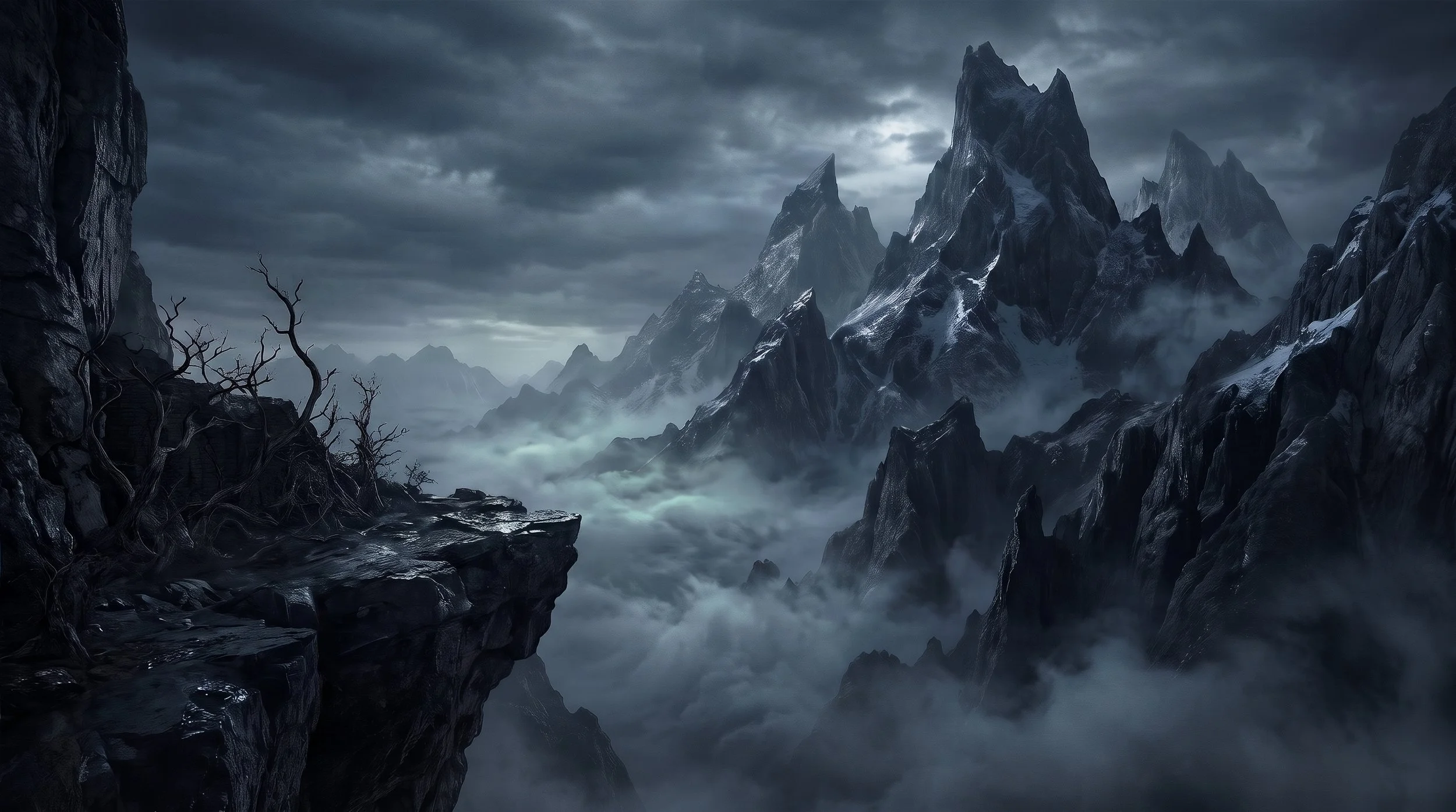
Being an account of the high passes, with certain testimonies gathered from travellers, soldiers, pilgrims and those charged with keeping the northern roads.
The Kharsads are among the oldest named places upon any surviving map of Cydonia. The name appears in rolls predating the present Crown, though no agreement remains as to its meaning. Some antiquarians have rendered it as the broken heights. Others maintain the word belongs to a tongue no longer spoken and should not be translated at all.
Among the common folk they require no translation.
They are simply called the cursed mountains.
No royal decree has ever named them so. No learned brother of the Chapterhouse will admit that stone and earth may carry a curse merely by existing. Yet caravans still make offerings before attempting the higher passes, muleteers knot rowan above their harness bells, and there are villages beneath the foothills where no man will point toward the peaks after nightfall.
The Kharsads have taken enough men that such customs endure without need of doctrine.
Of the Mountains
The lower slopes are heavily wooded, broken by steep ravines and streams fed from the high snow. Above the tree line the land becomes bare and difficult, with long shelves of grey stone divided by chasms, scree and narrow passes where two laden horses can scarcely walk abreast.
Snow may remain upon the highest ground throughout the year.
Weather in the Kharsads is notoriously uncertain. Clear skies have been known to close within the span required to saddle a horse. Fog gathers without rain. Winds descend from the higher valleys without warning and are said by travellers to carry voices over impossible distances.
Such things may be accounted for by the nature of the country.
Other matters are less easily dismissed.
There are valleys in which sound behaves strangely. Men have heard the bells of their own pack animals from ahead of them upon the road. Others have heard hoofbeats following for half a day without ever seeing a rider.
More troubling are the reports of paths which alter.
A cairn passed in the morning may be encountered again before dusk despite a company having travelled steadily north. Streams marked upon reliable charts have been found running upon the wrong side of a ridge. Men who swear they descended for hours have emerged upon ground considerably higher than that from which they began.
These accounts are common enough that experienced guides advise travellers never to leave the marked passes merely because another road appears easier.
Particularly when that road bears paving stones.
Of the Dead Roads
Scattered throughout the Kharsads are remnants of roads whose makers are unknown.
Some consist only of dressed stones visible beneath moss or snow. Others run for considerable distances through country where no settlement has stood within recorded memory. Their construction bears little resemblance to the roads of Cydonia or the neighbouring realms. The stones are fitted without mortar and, where undisturbed, remain remarkably even despite their presumed age.
No milestones have been found.
No royal marks appear upon them.
Many end abruptly against cliff faces or disappear beneath earth and scree.
Border folk call them the Dead Roads.
There are few customs concerning the Kharsads upon which guides agree, but regarding the Dead Roads their counsel is remarkably consistent.
Do not travel them after sunset.
Do not follow them into fog.
And if a road appears where none was present before, leave it untouched.
A survey party sent into the eastern heights during the reign of King Edric is said to have ignored the latter warning. Their instructions were to determine whether one such road might provide a shorter passage through the mountains.
Seventeen men entered the high country.
Four returned.
None would describe where the road had taken them.
The surviving record notes only that all four refused thereafter to sleep beneath a roof.
Concerning the Missing
Men disappear in mountains.
The Kharsads possess cliffs enough to kill the careless, winters enough to kill the prepared, and wolves enough to dispose of what remains. Many disappearances attributed to the mountains require no darker explanation.
Others have proved more difficult.
Caravans have been found abandoned with goods untouched and animals still tethered.
Campfires have been discovered cold beside bedrolls containing boots, cloaks and weapons, with no tracks leading away.
During one winter patrol, six men of the northern watch vanished while travelling between two established way shelters less than half a day's march apart. Searchers found their horses three days later standing together beneath a rock overhang.
The saddles remained fastened.
The men's packs remained strapped behind them.
There was no blood.
No bodies were recovered.
The incident would have joined the many ordinary losses of the mountains had one of the missing men not walked into a village beneath the southern foothills the following spring.
He believed only two nights had passed.
Of Those Who Return
It is from such accounts that the darker reputation of the Kharsads has grown.
For some who vanish within the mountains return.
Not all return unchanged.
The records differ greatly concerning what form these changes take. Some travellers suffer little more than confusion, lost memory or the effects of exposure. Others return unable to account for days or weeks of their absence.
A few accounts are less comfortable.
One drover returned to his household after being missing through an entire winter. He recognised his wife, his sons and every man in his village, yet insisted the house in which he had lived for twenty-three years had been built facing the wrong direction.
He refused to enter it.
When forced inside, he became violent and attempted to break through the northern wall with an axe.
He died of fever three days later.
Another account concerns a pilgrim who became separated from his companions during heavy fog. He returned before dawn and continued the journey with them. Nothing unusual was remarked until they reached the lowlands, where the man began asking why their shadows followed them.
His companions first believed this a jest.
It was not.
For the remainder of his life he refused to walk outside on a clear day.
There are tales of others who returned without recognising their own names. Men who spoke during sleep in languages no priest or scholar could identify. Men who woke screaming whenever church bells sounded. Men who refused to look into still water.
Such stories are commonly exaggerated in their telling.
The difficulty lies in determining where the exaggeration begins.
The Traveller's Warning
Those who live nearest the Kharsads maintain a body of customs concerning passage through the mountains.
Never answer a voice you cannot see.
Never follow bells after dark.
Never disturb a cairn unless you raised it yourself.
If fog overtakes the road, remain where you are until it passes, even if familiar voices call from farther ahead.
Above all, travellers are warned to count their company before entering the high passes and again before leaving them.
The origin of this final custom has been lost.
One version holds that a caravan once descended from the Kharsads with one traveller more than had entered.
Another claims there was one fewer, though every man present swore nobody was missing.
Neither account names the caravan.
Both are old.
Of the Curse
What, if anything, lies behind the reputation of the Kharsads remains uncertain.
The Chapterhouse has repeatedly dismissed claims that the entire range stands beneath supernatural malediction. Learned authorities point instead to altitude, hunger, solitude, cold and fear, all of which may disorder the mind of a traveller and give substance to things that are not there.
This explanation is sensible.
It is also the explanation preferred by men who have never crossed the Kharsads.
Those who have tend to speak less certainly.
A border saying holds that every mountain takes its due in blood.
The Kharsads, men say, are merely less particular about what they take.
For this reason the wise traveller keeps to the known passes, leaves the Dead Roads to the dead, and does not concern himself overmuch with lights seen upon the high ridges after sunset.
There are no settlements there.
There are no watchfires there.
And whatever walks those roads in the darkness has had them to itself for a very long time.